

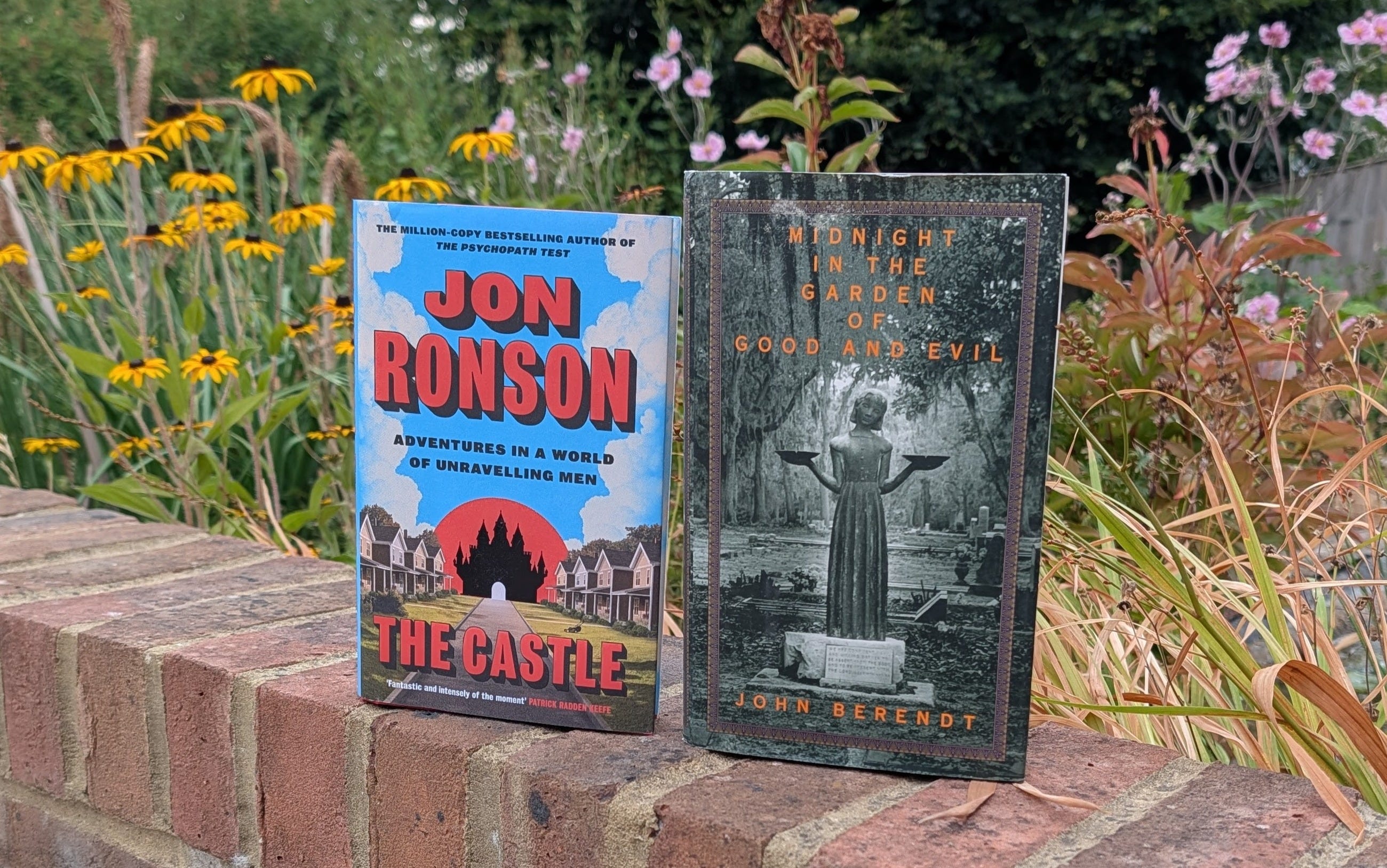
Although I have been reading Jon Ronson for years, I had not known or noticed that one of his key inspirations back in the ‘90s was a book called Midnight in the Garden of Good and Evil by John Berendt. Midnight in this sense is partly a concept: the idea of a period of time, a threshold, between good goings on and the bad stuff.
I had already heard of the title through osmosis. It’s a brilliant title. But I had assumed it was a movie or a novel of some kind. But what was it about and why did it inspire Jon Ronson? I ordered a copy the minute I finished The Castle, Ronson’s latest book. At the rate he writes them, I decided I needed more. Earlier this summer I had devoured London Falling, another book of the moment.
These three books all have something in common. There is a central mystery or puzzle to help you along, to pull you forwards. London Falling is more centred on a central narrative, some might say a plot, than the other two. Like The Castle, Midnight could have been a collection of character studies on a theme, of a place, but in the final analysis they would have been something less than the impact of these books, a hodge podge of disconnected character studies. What drives John Berendt forwards, and what pulls the reader along is that one of his characters shoots another one and kills him in circumstances which were hotly disputed and decidedly suspicious, and remain so.
Berendt has played loose with the timeline, of course. How likely is it that a murder happens right in the middle of his sleepy town story set in Savannah, Georgia? Not very. He makes out that the murder happens in the midpoint of his book. How convenient! No, he had chosen Savannah because of the murder. Nobody is that lucky. Or unlucky, if you were the victim.
Anyway, it turns out that there was a movie made of the book, in 1997, directed by Clint Eastwood and starring John Cusack as the local journalist. So not a literal interpretation of the book, but relatively close. The movie therefore adapts a story that had already been heavily edited in the book.
A challenge with books like Midnight, and like Ronson’s, is the time they take to research. Berendt spent a decade on his book, which became an ‘overnight’ success, spending four years on the NYT bestseller list, a record to this day and one it is difficult to imagine being broken in our time of short attention spans.
It was another decade before Berendt’s second book emerged. The City of Falling Angels was set in Venice in the aftermath of an enormous fire. Nobody is this lucky. The fire obviously happened before Berendt arrived... unless he started it? Yes, it is very difficult to find these stories in the real world. Novelists have no idea how easy their lives are.
Those two books were all John Berendt wrote in that form. He had a long career prior as a regular writer at magazines like Esquire. He was editor of New York magazine. Impossible to imagine someone having a middle class career as a magazine columnist any longer. Berendt might not have written many books but indirectly we have him to thank for the few that Jon Ronson has penned. By Berendt standards, Ronson is fiendishly prolific.
I first came across Ronson when he was on TV trailing the sinister Bilderberg Group around town during one of their secret conferences. Members of the group were people like prime ministers, royals and billionaire tycoons back when they were only millionaires. From their secret castle conferences they plotted world domination and ran secret societies. Later on some people would attribute similar powers to the Carlyle Group, private equity villains who recruited people like John Major and swanned around… but only in private. They were protected by sinister-looking security dudes wearing black suits and black sunglasses. If they still do it (I checked: they do!) they will definitely be wearing Meta Ray-Bans. Only a loony would drive around town following these Bond villains around. Enter Jon Ronson.
Since those japes, Ronson has polished and finessed his method. Each of his recent books digs deep into a theme that is especially relevant to the time he is writing in. So it would have been a quarter of a century ago that Jon wrote about Bilderberg in his book THEM: Adventures with Extremists. In 2001, of course, there were much bigger baddies around than the grey suits of the Bilderberg.
It was during Jon’s THEM era that he met Uri Geller in central London, right at the start of the war on terror in October 2001. Uri, he of the bendy spoons, claimed to have worked as a psychic spy in the 1970s for the CIA. This wasn’t the first or last outlandish claim made by Geller, perhaps to keep his name in people’s minds, but it turned out to be true, more or less. The trail led Ronson to discover a concept called ‘pyschic soldiers’, men who (literally) stared at goats to make them fall over. A man who can make a goat fall over can, perhaps, also walk through a wall on a whim. These men practiced actual invisibility too. There was sleight of hand involved, slightly. No laws of physics were broken.
These men, senior US soldiers, caught the imagination of George Clooney, who starred in the movie, and this is the way many people first heard of Jon Ronson.
Strangely enough, mind control is present in John Berendt’s Savannah book. His main character practices a game called Pyscho Dice. I think Psychic Dice is a more accurate term but it’s not what they called it. Basically the idea was that you can influence the number shown on a die by thought alone. If you can do that, you can perhaps influence a jury to find you not guilty too. You see the potential now? Yes, the dice guy was also the murder suspect.
By even stranger coincidence, as I was reading Midnight this week, I came across the term ‘dynamite charge’ in relation to a court case in which the jury cannot agree on a verdict. That phrase entered the world’s consciousness in relation to last week’s mistrial involving Lindsay Clancy. The judge in that case also read out this so-called dynamite charge (which is massively less exciting than I assumed) but failed to avoid a mistrial due to an unduly stubborn juror who allegedly refused to discharge their duties. Although we are not officially allowed to know exactly what happened, common consensus in the media is that 11 jurors were reassured that Clancy was not in control of herself when she killed her children. Very few of us, me included, are deeply across the evidence yet have very strong opinions on the case. Much of modern life is like that: you see a headline, make a snap judgement, and then defend it to the death on social media.
So my point is that you can see echoes of Berendt through Ronson’s books if you start looking.
The goats were really an aberration. No other Ronson book focuses so tightly on a single story, complex though it might be. The goats came out around 2004 and then there was a long silence as Ronson researched his own landmark book, The Pyschopath Test, a book he was flogging when I saw him in the garden of a pub in Hurley sometime around 2011, just after the book came out. I saw him playing with his dog. This might not be the same dog, Bonnie, who is mentioned in The Castle.
Jon’s young son, Joel was with him, perhaps 12 or 13 at the time. Jon spoke later in the Tithe Barn. I had no idea then that he would still be flogging the book in 2025 when I saw him in Aylesbury in a bigger production involving special guests, including the man wrongly convicted of killing Rachel Nickell on Wimbledon Common, Colin Stagg. It was a very thought-provoking night. And that is why so many of us are thirsty for the sort of fayre that Ronson dishes out. He provokes thought. Yes, he adds a few jokes and possibly exagerrates things to ramp up the humour, but the result is extremely powerful. He tries not to take sides but it feels like he wants to side with many of the highly unconventional people he meets. He is, afterall, a man with an unconventional career himself.
It was a comparatively short four years before we were treated to the next book, So You’ve Been Publicly Shamed, dealing with cancel culture and in particular how completely private, non-celebrity people were being highlighted in global news for some misconstrued tweet. It was a frightening time that is fading now, yet social media is still seen largely as a social ill, a far cry from those early days of Twitter when it felt like we were all friends. Why is it that there is always someone to piss in the soup? What if it turned out that the tech bros behind those so-called social platforms were actively manipulating us all to turn against each other? Surely the definition of evil. Luckily they were so easy to hate, Musk, Zuckerberg and all the rest.
And then Ronson went quiet for a decade. Not if you knew where to look, of course. He had turned to podcasting for Amazon and the BBC. He interviewed porn stars for The Butterfly Effect, which looked more generally at how tech bros had infiltrated almost every corner of society, fouling the pavements with their apps and platforms that trashed long-established industries and made us all feel obliged to gratefully thank them for robo taxis, dark kitchens and all kinds of other nefarious monstrosities. I understand there is another series of Things Fell Apart coming this winter on the BBC.
But for today, rejoice! An actual book has popped out of Ronson Towers. The Castle is what drew me to Oxford last night to see Ronson in person for the third time. This was the only time my wife and daughter had been present. What would the next generation make of this journalist who has been such a big part of my reading and listening habits for 25 years?
The answer is that Jon’s talk went across very well with my 15 year-old. In particular she was observed laughing uncontrollably at the footage from YouTube Kids, the horror version of Peppa Pig and the stuff with the 18-rated dentist appointment, the needles and guns. On close questioning afterwards, it emerged that she had been exposed to exactly this kind of material during the period of time that YouTube Kids was inadvertently dispensing such decidedly not kid-safe content.
You never quite know what to expect from a Ronson evening. There were no special guests this time but he more than made up for it with a Keynote-maxxx presentation containing many still photos and interview excerpts from his research. I had already read the book (gold star to me) and I found that hearing the protagonists in their own words was an arresting and moving experience. I do love books and the written word, but actually hearing these people talk was a special privilege.
Jon is right at the start of his tour, so there is plenty of time to grab a ticket. Indeed we saw the first public version of this show after what sounded like a memorable private preview at the Groucho the previous evening.
You can avail yourself of a ticket to see Jon talk about The Castle here.
I think I came across Jon Ronson's and John Berendt's work years ago without remembering names. Definitely recall reading an article or book titled "The Men Who Stared at Goats", and I saw a TV documentary on Colin Stagg in which he met Paul Brittain (the psychiatrist whose profile of Rachel Nickell's killer was erroneously used by the police to blame him - Brittain's book "The Jigsaw Man" is a brilliant read and probably the seminal work on criminal profiling).
There's actually a good few experts spanning psychiatry, psychology and law enforcement, who have blown the cobwebs off the academic side of criminology and are sharing their thoughts with the masses. Thinking Joe Navarro and the many experts who regularly contribute to shows such as "Murder By the Sea" (my mother and I are addicted to this show which, despite its dark theme, is oddly comforting; Geoffrey Wansall eating chips on the seafront just makes you feel all is "normal" - it really plays to people's sense of safety in familiarity).
All these guys' research and presentation is the gold standard of journalism: interesting (both of interest and in the public interest because it teaches us how to recognise subtle signs of danger aka "red flags"), meticulously researched (including through first-hand, with face-to-face interviews) and presented in such a way that it reaches the broadest audience possible.
Delighted to hear your daughter enjoyed the Jon Ronson show; if she ever wants to do a podcast like yours she could call it Crime Gal.