

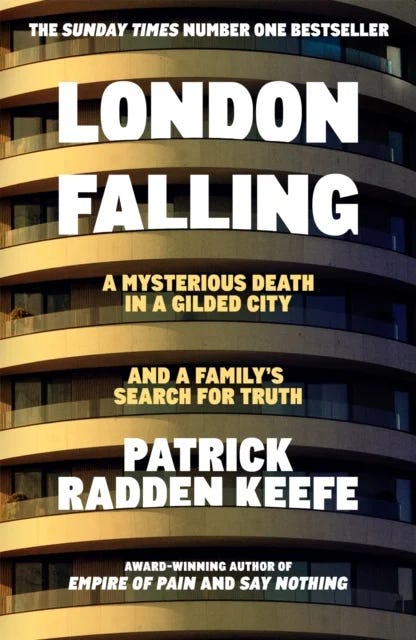
This article discusses the book, London Falling, which is based on the New Yorker article A Teen’s Fatal Plunge Into the London Underworld and contains significant spoilers.
Crime Guy has been on a lull until this week, when I just happened to search again for updates on Sophie Toscan du Plantier. I found one, to my surprise, but as so often in that case, the exciting possibilities simmered away and I ended up thinking that this was most likely not the smoking gun that we all wait for.
London Falling is excellent, by the way. If you are short on time you can read the New Yorker article instead, or watch the interview the author gave to Sarah Jessica Parker in New York recently.
However I was not reading London Falling in the way that normal people read books. For a start, I raced through it in less than 24 hours. I skimmed a few pages which were more about the London context written for a US audience, stuff I already knew, and things I felt to be digressionary. I was reading the book with a new project in mind.
Jon Ronson, a hero of mine, describes the book as ‘breathtaking’ which I found disappointing and unlikely. Jon is a many of so many words himself that the idea of him summarising anything this succinctly is laughable. But he had read it, and he did like it. His own eagerly anticipated new book, The Castle, is due in August.
As I draw to the end of a year-long quest to find new information about everyone’s favourite band, Fleetwood Mac, I am keen to find the next writing project before I finish that story. There is nothing worse than not having a project on, nothing more risky than a lull in proceedings.
I have spent the last year writing a lot about music, both for that book and here on Substack as Tennessee Vibes. I continue to try to get a book project commissioned to write about today’s new and upcoming indie artists. Strangely, publishers do not think that will sell. We love historical music writing, they tell me; nobody wants to read about unknowns. And so that continues as an online project.
The nearest example of what I think of as my ideal writing project so far has been the Sophie Toscan du Plantier case. One of the ways online journalism improves upon the constraints of a book is that, like the mystery surrounding Sophie’s murder, the story never ends. The medium follows the story: it loops on endlessly for decades, likely never to resolve. That kind of crime book leaves most people unsatisified because everyone likes a story to have an ending. Indeed, many people think that is one of the key component aspects of a story.
London Falling has an ending, but not one you will love. You can probably take an educated guess about what it might be. Zac Brettler did not ‘fall’ from that building because MI6 have video footage of him leaping. So the only question is: why did he jump?
There are people who will tell you he was depressed and lonely, and that he jumped to kill himself. Nobody who is familiar with that stretch of river will believe that. The 5th floor looks surprisingly low rise, and it is very close to the river bank. The way Zac walked along the balcony, back and forth, indicates careful preparation. He is in fact trying to escape something going on in the apartment. He is trying to save himself. He jumps from the point nearest to the river, hoping to swim to safety.
And so while the book has an ending, the story does not. One option I have is to pull on a few untied strings in this story, to see if it can be pushed forwards. Like Suzy Lamplugh, another person I believe ended up in the Thames, Zac’s story ends in London and is much easier for me to research. Everyone has to build a reputation before they turn into someone like Patrick Radden Keefe. You have to start small, as I did with Sophie, five years ago, when there was no Crime Guy at all, just a random blog on Medium.
I have asked you guys before but are there any really great crime stories that deserve closer inspection? I am tending to interpret crime much more widely these days and am drawn to a big corporate story such as the downfall of RBS, which took up two or three years of my time a decade ago.
London Falling suggests there would be a public interest in highlighting the business affairs of one of the few extant protagonists, Akbar Shamji, but has Keefe done the job too well? Possibly there are new angles there.
Let me know what you think in the comments.
It does sound interesting for me to have a look at this case. I do think I have read about it in a newspaper article
Interesting take. As I am not a native London or nor a UK native when I read this, I’m going to read it from your perspective because this is interesting. I wonder if it is the story itself that is important or the backstory of London that you refer to. Was there a particular portion of the book that you did like? Thanks for the review.